
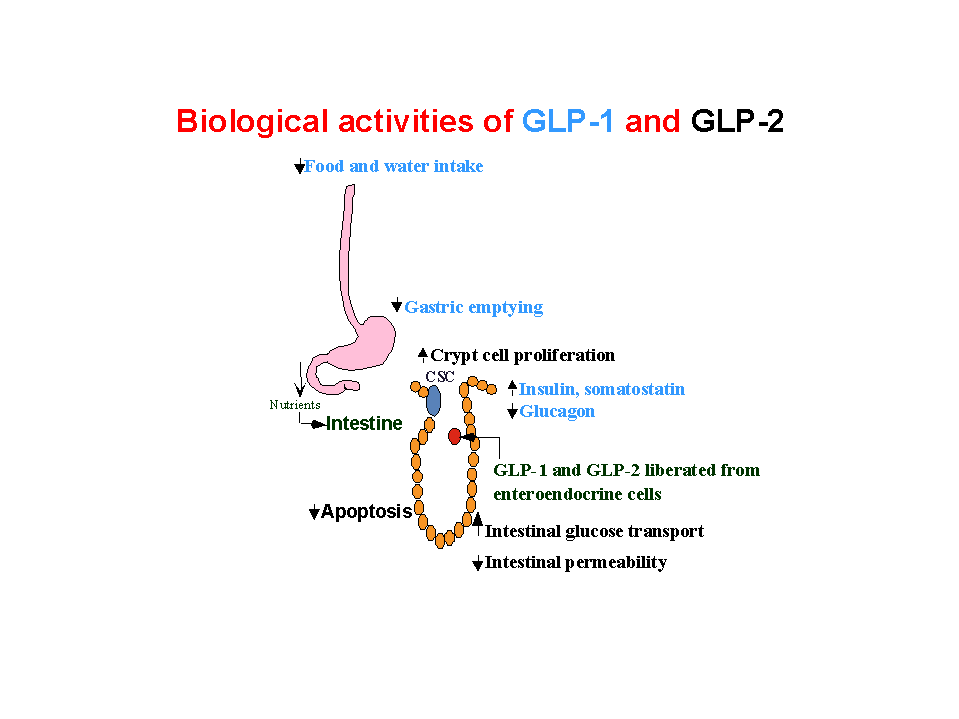
A single glucagon gene encodes a larger biosynthetic precursor, proglucagon, in mammals. Tissue-specific processing of proglucagon gives rise to glucagon in the brain, and glicentin, oxyntomodulin, GLP-1, and GLP-2 in the intestine, with an intermediate profile of peptides liberated in the central nervous systemFor a summary of GLP-1 and GLP-2 action, see Glucagon-like peptides. Diabetes. 1998 Feb;47(2) :159-69
Glucagon gene expression
 A primary question under study is how the synthesis of the
proglucagon-derived peptides is regulated in each tissue. These studies use a
combination of in vivo physiological approaches in animals, primary cell
cultures, cell transfection experiments, and transgenic mice, to define the
physiological and molecular mechanisms regulating transcription of the proglucagon gene. An important question is the identity of a) transcription
factors that specify tissue-specificity, and the understanding of the b) physiological mechanisms that
regulate induction and suppression of proglucagon gene expression in vivo
A primary question under study is how the synthesis of the
proglucagon-derived peptides is regulated in each tissue. These studies use a
combination of in vivo physiological approaches in animals, primary cell
cultures, cell transfection experiments, and transgenic mice, to define the
physiological and molecular mechanisms regulating transcription of the proglucagon gene. An important question is the identity of a) transcription
factors that specify tissue-specificity, and the understanding of the b) physiological mechanisms that
regulate induction and suppression of proglucagon gene expression in vivo
Although no mutations to date have been detected in the proglucagon gene or receptors for the PGDPs that link to inheritance of specific diseases, intriguing genetic data suggests an association between specific SNPs in intron 3 of a proglucagon gene transcription factor, and an increased risk for developing type 2 diabetes. Tianru Jin and colleagues previously demonstrated that intestinal proglucagon gene expression is regulated by the Wnt/TCF-4 pathway specificazlly in enteroendocrine cells. TCF-4 mediates cell type-specific regulation of proglucagon gene expression by beta-catenin and glycogen synthase kinase-3beta. J Biol Chem. 2005 Jan 14; 280 (2): 1457-64
Glucagon gene transcription in the pancreas
Studies using isolated islet cell lines have demonstrated that insulin directly inhibits islet proglucagon gene expression via regulation of gene transcription Glucagon gene transcription is negatively regulated by insulin in a hamster islet cell line. J Clin Invest. 1989 Aug; 84(2) : 672-7. It has been difficult to separate the effects of glucose from those of insulin on the inhibition of glucagon gene transcription, since an elevation in blood glucose rapidly leads to stimulation of insulin secretion which together exert a negative inhibitory effect on the α cell. Whether glucose directly regulates proglucagon gene expression is unclear Insulin, but not glucose lowering corrects the hyperglucagonemia and increased proglucagon messenger ribonucleic acid levels observed in insulinopenic diabetes. Endocrinology. 1998 Nov;139(11):4540-6.
A series of studies by Jacques Philippe and colleagues have identified specific DNA sequences in the proximal 5'-flanking region of the rat proglucagon gene G3 promoter element that appear to be critical, in promoter studies, for insulin-dependent inhibition of glucagon gene transcription as outlined in Insulin regulation of the glucagon gene is mediated by an insulin-responsive DNA element. Proc Natl Acad Sci U S A. 1991 Aug 15;88(16):7224-7 and Islet-specific proteins interact with the insulin-response element of the glucagon gene. J Biol Chem. 1995 Feb 17;270(7):3039-45. Subsequent studies from the Knepel lab demonstrated that the insulin-mediated regulation of proglucagon gene expression is complex, and likely involves multiple elements from both the proximal promoter, together with more distal elements as described in Insulin responsiveness of the glucagon gene conferred by interactions between proximal promoter and more distal enhancer-like elements involving the paired-domain transcription factor Pax6. J Biol Chem. 2000 Sep 29;275(39):30037-45
A role for Foxo1 as a critical regulator of proglucagon gene expression was identified in studies using mouse islet cells, predominantly in aTC1-9 cells. Foxo1 was localized to both α and β-cells by immunohistochemistry and insulin but not glucose caused nuclear to cytoplasmic translocation of Fox01 in aTC1-9 cells. Reduction of Foxo1 expression using siRNA reduced basal levels of proglucagon mRNA transcripts and eliminated the inhibitory effects of insulin on proglucagon gene expression. Three putative Foxo1 binding sites were identified in the rat proglucagon gene promoter whereas one of the sites, designated GL3 (-1792to -1798), appeared critical for both basal proglucagon promoter activity and for the effects of both insulin and Fox01 on proglucagon gene expression. Hence, Foxo1 binding, together with the more proximal promoter elements described above, contributes to insulin-regulated inhibition of proglucagon gene transcription. See FoxO1 is required for the regulation of preproglucagon gene expression by insulin in pancreatic alpha -(TC1-9) cells. J Biol Chem. 2006 Oct 24; [Epub ahead of print]
Efforts in several laboratories are directed at understanding tissue-specific control mechanisms, focusing on DNA regulatory sequences and transcription factors, that regulate both the rat and human proglucagon gene promoters. These studies, together with findings from other labs, have identified isl-1, cdx-2/3, pax-6, HNF-3a, HNF-3b, and brn 4 as important proglucagon gene transcription factors. Although the majority of these factors have been characterized using cell transfection studies, several have also been analyzed using transgenic mice in vivo. For example, targeted inactivation of the isl-1 gene demonstrates an essential requirement of isl-1 for formation of islet α cells Independent requirement for ISL1 in formation of pancreatic mesenchyme and islet cells Nature. 1997 Jan 16;385(6613):257-60
HNF-3 (Foxa) proteins, initially HNF-3b, regulate proglucagon gene transcription via the G2 promoter element. Transfection of islet cell lines reveals an inhibitory role for HNF-3 Glucagon gene expression is negatively regulated by hepatocyte nuclear factor 3 beta. Mol Cell Biol. 1994 May;14(5):3514-23, however several HNF-3b isoforms have been detected in islet cells, with varying transcriptional properties Hepatocyte-nuclear factor 3 beta gene transcripts generate protein isoforms with different transactivation properties on the glucagon gene. Mol Endocrinol. 1995 Mar;9(3):368-74. More recent experiments suggest that HNF-3a and HNF-3b may also modulate (impair) proglucagon promoter activity via interaction with pax6 through the more proximal G1 element. See Hepatic Nuclear Factor-3 (HNF-3 or Foxa2) Regulates Glucagon Gene Transcription by Binding to the G1 and G2 Promoter Elements. Mol Endocrinol. 2002 Jan 1;16(1):170-183
Although islet α cells and enteroendocrine cells form normally in HNF-3a -/- mice, proglucagon gene expression in the pancreas is inappropriately reduced in the face of fasting hypoglycemia, demonstrating an essential role for HNF-3a in proglucagon gene expression. Kaestner, K.H., Katz, K., Liu, Y., Drucker, D.J. and Schutz, G. Inactivation of the winged helix transcription factor HNF3a affects glucose homeostasis and islet glucagon gene expression in vivo 1999 Genes & Development 13:495-504
 Pax6 and cdx-2/3
cooperate, together with p300 in the synergistic regulation of proglucagon gene
transcription in islet cells. A model for these interactions is proposed in Glucagon
gene transcription activation mediated by synergistic interactions of pax-6 and
cdx-2 with the p300 co-activator. J Biol Chem. 1999 Oct 8;274(41):28950-7.
Pax6 and cdx-2/3
cooperate, together with p300 in the synergistic regulation of proglucagon gene
transcription in islet cells. A model for these interactions is proposed in Glucagon
gene transcription activation mediated by synergistic interactions of pax-6 and
cdx-2 with the p300 co-activator. J Biol Chem. 1999 Oct 8;274(41):28950-7.
The activity of pax6 on the G1 element in islet α cells may also be enhanced by interaction with Maf transcription factors, members of the bZip family. See Interaction of Maf transcription factors with Pax-6 results in synergistic activation of the glucagon promoter. J Biol Chem. 2001 Sep 21;276(38):35751-60
Several lines of evidence support a role for Pax6 as a key determinant of human islet function. Human subjects with a mutation in the Pax6 gene encoding for a truncated protein exhibit impaired Pax6-dependent transcriptional activity and impaired glucoswe tolerance with reduced insulin secretion. PAX6 mutation as a genetic factor common to aniridia and glucose intolerance Diabetes. 2002 Jan;51(1):224-30. Ahlqvist reported that subjects harboring a Pax6 SNP rs685428 AG(in the non-coding region) exhibit reduced islet Pax6 and Pcsk1 expression, a lower proinsulin:insulin ratio, decreased arginine-stimulated insulin levels, and reduced circulating levels of GIP and glucagon, however the risk of developing diabetes was not increased in subjects with this allele A common variant upstream of the PAX6 gene influences islet function in man Diabetologia. 2011 Sep 16.
The related paired domain protein pax-2 is also expressed in islet cells in multiple isoforms and regulates proglucagon gene transcription through the G3 and G1 promoter elements. See The paired-homeodomain transcription factor Pax-2 is expressed in the endocrine pancreas and transactivates the glucagon gene promoter
A role for the pbx-1 homeobox genes, in association with the prep-1 homeobox gene, is suggested by studies demonstrating binding of these proteins as heterodimers to different regions of the proglucagon gene promoter in islet α cells. The physiological significance of these interactions remains unclear, and awaits studies of global or islet-cell specific knockouts of these transcription factors.
Similarly, GATA-4 has been shown to be expressed during embryonic development of islet α cells, and may play a role in the control of fetal proglucagon gene transcription via interaction with the proximal G5 promoter element. GATA-4 was not detected in the adult islet α cell. See The zinc finger-containing transcription factor Gata-4 is expressed in the developing endocrine pancreas and activates glucagon gene expression. Mol Endocrinol. 2004 Nov 11;
The Arx transcription factor plays an important role in the specification of a-cells in the endocrine pancreas. Inactivation of Arx leads to a complete loss of a-cells and glucagon in mice and in humans Partial loss of pancreas endocrine and exocrine cells of human ARX-null mutation: consideration of pancreas differentiation Differentiation. 2010 Sep-Oct;80(2-3):118-22 with maturally ocurring Arx mutations. The transcription factor islet-1, previously shown to be an important regulator of islet proglucagon gene transcription, is also an important determinant of Arx expression in islet a-cells. Arx expression is reduced in islet-1-/- pancreas and transgenic over-expression of islet-1 in islets increases expression of Arx. The effect of islet-1 may be located through binding sites in the 3'-flanking region of the Arx gene Islet-1 regulates Arx transcription during pancreatic islet {alpha}-cell development. J Biol Chem. 2011 Mar 9. [Epub ahead of print]
Nevertheless, complete disruption of the murine glucagon gene, and corresponding elimination of the production of glucagon, GLP-1, GLP-2, and all proglucagon-derived peptides, results in surprisingly normal mice, with fairly normal glucose homeostasis. The phenotype of the Gcg-/- mice most closely resembles the findings observed in Gcgr-/- mice, with normal body weight and food intake, reduced locomoter activity, normal numbers of L cells and progressive development of a-cell hyperplasia Mice deficient for glucagon gene-derived peptides display normoglycemia and hyperplasia of islet {alpha}-cells but not of intestinal L-cells Mol Endocrinol. 2009 Dec;23(12):1990-9. Epub 2009 Oct 9
Mice with complete deficiency of all PGDPs also develop islet cell hyperplasia (arising in cells that express GFP under the control of the Gcg locus), and over time, pancreatic endocrine tumors that can be metastatic to liver and lung resulting in significantly reduced life span. As was the case for studies carried out by Longuet et al using islet from mice with liver-specific disruption of the Gcgr, tumors from Gcg-deficient mice exhibit enhanced proliferation under the kidney capsule of Gcg-deficient mice, consistent with existence of one or more circulating factors that promote a-cell proliferation in the context of glucagon deficiency Pancreatic Neuroendocrine Tumors in Mice Deficient in Proglucagon-Derived Peptides PLoS One. 2015 Jul 20;10(7):e0133812
A study of several unrelated populations demonstrates a genetic association between inheritance of a specific SNP, the microsatellite, DG10S478, within intron 3 of the transcription factor 7–like 2 gene (TCF7L2; formerly TCF4) and an increased risk for development of type 2 diabetes. These findings raise the possibility that this SNP modifies disease susceptibility through modulation of intestinal proglucagon gene expression and plasma levels of GLP-1, as suggested in Variant of transcription factor 7-like 2 (TCF7L2) gene confers risk of type 2 diabetes online: 15 January 2006; | doi:10.1038/ng1732
How does insulin inhibit proglucagon gene expression? Insulin is perhaps the most potent negative regulator of glucagon secretion, however whether insulin and/or glucose directly inhibits proglucagon gene expression in vivo has been somewhat controversial, as outlined in In vivo effects of glucose and insulin on secretion and gene expression of glucagon in rats. Endocrinology. 1995 Dec;136(12):5370-6 and Insulin, but not glucose lowering corrects the hyperglucagonemia and increased proglucagon messenger ribonucleic acid levels observed in insulinopenic diabetes. Endocrinology. 1998 Nov;139(11):4540-6.
Gastrin has been invoked as both a regulator of glucagon secretion and glucagon gene expression. Although basal levels of glucagon gene expression are normal in gastrin -/- mice Hypoglycemia, defective islet glucagon secretion, but normal islet mass in mice with a disruption of the gastrin gene.Gastroenterology. 2003 Oct;125(4):1164-74 gastrin augments proglucagon promoter activity and glucagon gene expression in islet cells transfected with the CCK-B receptor. The effects of gastrin on the proglucagon promoter are mediated by the Egr1 transcription factor interacting with the G4 promoter element as shown in Essential interaction of Egr-1 at an islet specific response element for basal and gastrin-dependent glucagon gene transactivation in pancreatic alpha cells. J Biol Chem. 2004 Dec 14; [Epub ahead of print]
Does glucagon autoregulate its own synthesis and secretion in the a-cell? The answer appears to be yes, but the direction of the autoregulation depends on the experimental model. Increased glucagon receptor signalling induced by administration of glucagon several times daily for up to 20 days produces marked atrophy of a cells in the endocrine pancreas and shuts of glucagon biosynthesis in the pancreas Effects of Long Term Administration of Glucagon on the Pancreatic Islet Tissue of Rats and Guinea-Pigs. Acta Endocrinol (Copenh) 1963;44:139-149 Similarly, experimental hyperglucagonemia in rodents with transplantable glucagonomas also produces rapid diminution of islet and a-cell mass, apoptosis of a-cells, and depletion of proglucagon mRNA expression and immunoreactivity of glucagon in the pancreas Potent inhibitory effects of transplantable rat glucagonomas and insulinomas on the respective endogenous islet cells are associated with pancreatic apoptosis. J Clin Invest 1995;96:2227-2235 and Inhibition of pancreatic proglucagon gene expression in mice bearing subcutaneous endocrine tumors. Am J Physiol Endocrinol Metab 1994;267:E662-E671. Atrophy of normal islet a-cells has also been observed in resection pancreas from patients with glucagonomas.
In contrast to the in vivo data, in studies employing islet cell lines, and isolated islets, Leibeger and colleagues report data illustrating that glucagon upregulates proglucagon gene promoter activity, proglucagon gene expression, and glucagon biosynthesis, findings postulated to be exerted through the glucagon receptor as they were sensitive to a peptide Gcgr antagonist Glucagon regulates its own synthesis by autocrine signaling Proc Natl Acad Sci U S A. 2012 Dec 3
Proglucagon gene expression in enteroendocrine cells
What are the differences in control mechanisms between islet vs. enteroendocrine proglucagon gene transcription? Yi and colleagues have shown that the Wnt pathway may regulate proglucagon gene transcription exclusively in gut endocrine but not in islet cell lines, and this cellular specificity may be attributable to tissue-specific expression of TCF4. See TCF-4 mediates cell type-specific regulation of proglucagon gene expression by beta-catenin and glycogen synthase kinase-3beta. J Biol Chem. 2005 Jan 14;280(2):1457-64
The importance of the pax6 transcription factor for control of intestinal proglucagon gene expression has been partially elucidated. Pax6 is expressed in intestinal enteroendocrine cells and activates proglucagon gene transcription. Remarkably, mice with a dominant negative pax6 mutation exhibit a virtual absence of gut endocrine cells that contain GLP-1 or GLP-2 immunoreactivity. Disruption of the murine pax6 gene markedly disrupts both islet development and selectively eliminates enteroendocrine cell populations in the small and large bowel, includingthe subpopulation of glucagon-producing enteroendocrine cells. These findings are published in the Essential requirement for Pax6 in control of enteroendocrine proglucagon gene transcription. Mol Endocrinol. 1999 Sep;13(9):1474-86
Analysis of the relative importance of Pax-6 versus Cdx-2/3 in the control of intestinal proglucagon gene expression was also carried out using a combination of intestinal endocrine cell lines, primary cultures of rat intestinal cells, and normal rats. Pax-6, but not cdx-2/3 activated intestinal proglucagon gene expression and GLP-1 biosynthesis in all three experimental models, including the normal rat gastrointestinal epithelium in vivo. See Pax-6 activates endogenous proglucagon gene expression in the rodent gastrointestinal epithelium. Diabetes. 2003 Feb;52(2):425-33.
Chepurny and colleagues characterized proglucagon gene expression in GLUTag cells, demonstrating that GPR119 activation increased proglucagon gene transcription through cAMP-dependent, Epac2-independent pathways. Expression of GPR119 in GLUTag cells was linked to enhanced proglucagongene transcription even in the absence of ligand, mechanisms involving α and β isoforms of type II but not type I PKA regulatory subunits.
One of the interesting features of proglucagon gene expression is the utilization of different tissue-specific promoters for regulation of gene expression in islets, intestine and brain. Furthermore, there is species-specificity in promoter utilization, lending additional complexity. Whereas ~1,250 nucleotides of the rat proglucagon gene promoter directs transgene expression to the CNS and pancreatic α cells Glucagon gene regulatory region directs oncoprotein expression to neurons and pancreatic alpha cells. Neuron. 1988 Sep;1(7):605-13. additional upstream sequences extending to -2,250 are required for expression in intestinal endocrine cells Glucagon gene 5'-flanking sequences direct expression of simian virus 40 large T antigen to the intestine, producing carcinoma of the large bowel in transgenic mice. J Biol Chem. 1992 May 25;267(15):10705-8
What mechanisms underlie regulation of human glucagon gene expression? Until recently, the only information on control of proglucagon gene transcription derives from studies of the rat gene. Surprisingly, despite the importance of the PGDPs for human biology, no information has appeared about the regulation of human proglucagon gene transcription. The control mechanisms regulating tissue-specific human proglucagon gene expression differ from those described for the rat gene. Cell transfection and transgenic experiments identified regions of the human proglucagon gene promoter functionally important for activating human proglucagon gene expression in the GI tract. These experiments appear in the Am J Physiol 1999 277:G829-G837 Divergent regulation of human and rat proglucagon gene promoters in vivo. Although nutrients up-regulate proglucagon gene expression in the gastrointestinal tract of mice and rats, the proximal region of the human proglucagon gene promoter is not sufficient for nutrient regulation of a human proglucagon promoter-hGH transgene in the small or large bowel of transgenic mice. See Human glucagon gene promoter sequences regulating tissue-specific versus nutrient-regulated gene expression. Am J Physiol Regul Integr Comp Physiol. 2002 282(1):R173-R183