Daniel J. Drucker Lab
Lunenfeld-Tanenbaum Research Institute
Mount Sinai Hospital
University of Toronto
Innovating the Science of Glucagon-Like Peptides
GLP-2
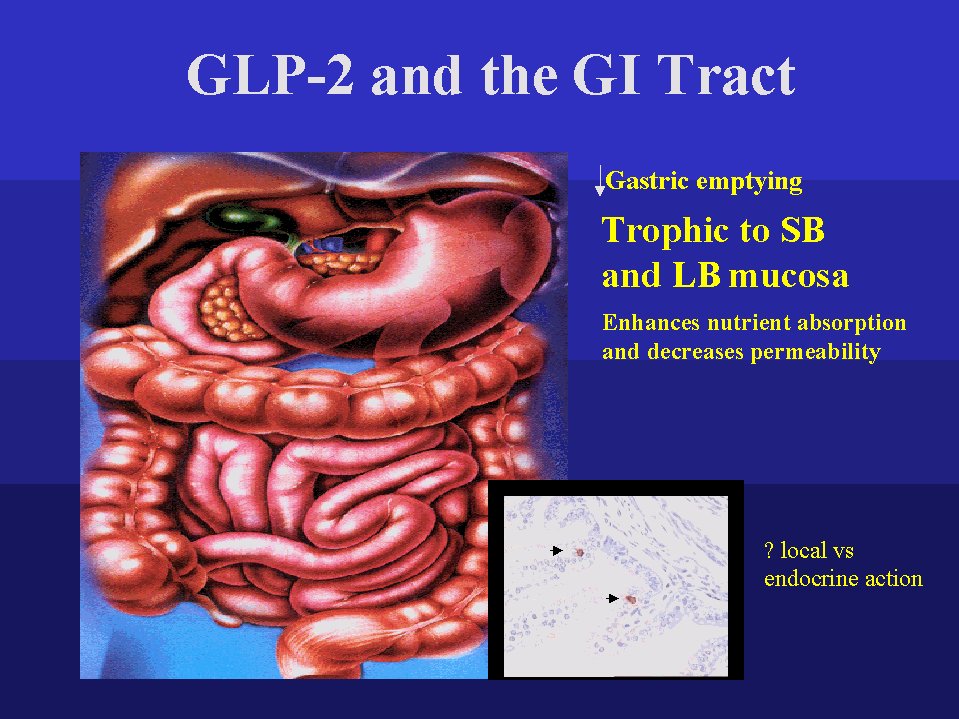
Glucagon-like peptide-2 (GLP-2) is a 33 amino acid peptide, co-secreted along with GLP-1 from intestinal endocrine cells in the small and large intestine
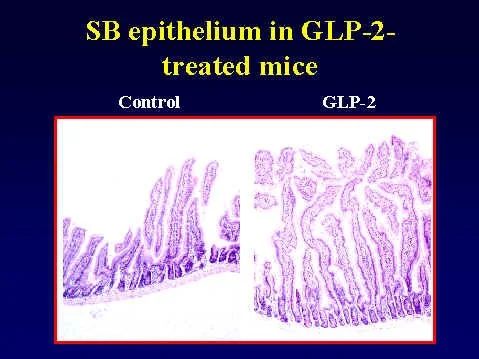
The function of GLP-2 was unrecognized for many years. The story starts with the observation that several human subjects with glucagonomas exhibit small bowel growth, as summarized in GLP-2 and Human Tumors. In 1996 GLP-2 administration in mice was shown to markedly increase small bowel growth in only a few days, principally due to hyperplasia of the villus epithelium
For an overview of how GLP-2 exerts its normal physiological effects, see the section on GLP-2 action.
To understand the molecular basis of GLP-2 action, review the data on the GLP-2 receptor.
For an overview of GLP-2 synthesis and secretion, see GLP-2 secretion and metabolism.
To review the importance of GLP-2 structure-function relationships, see GLP-2 structure and activity and DPP-4 and GLP-2.
To review the potential therapeutic efficacy of GLP-2, see GLP-2 and intestinal disease
For an overview of GLP-2 action in the brain, see GLP-2 and the CNS
To review experiments examining the essential physiological actions of GLP-2, See Essential GLP-2 action: Studies with antagonists